Measuring Nanometers: Capacitive Sensors / for Nano-Measuring / Nanometrology
Capacitive sensors (capacitance gauges) are the nanometrology technology of choice for the most demanding precision positioning, scanning and measurement applications, when it comes to measuring small distances with nanometer resolution and below. PI capacitive sensors ensure highest accuracy, resolution, linearity and longterm stability. These absolute-measuring, non-contact devices detect motion
at sub-nanometer levels witout contact, directly. They provide a combination of accuracy, linearity, resolution, stability and bandwidth superior to conventional sensors such as LVDTs and strain gauge type sensors (piezo resistive sensors).
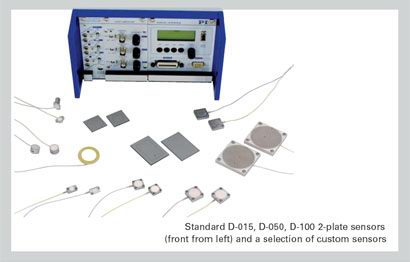
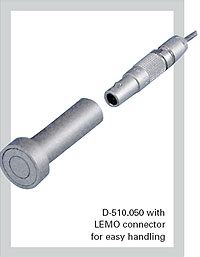
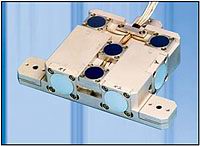
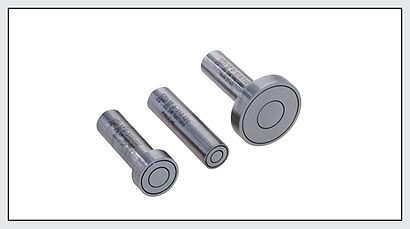
For the ultimate performance the D-015 - D-100 two plate sensor series are available. The single-probe D-510 series provide similar precision and feature an integrated LEMO connector for easy mounting and replacement in the field.
Single-Probe Capacitive Position Gauge for Nanometrology Applications
The D-510 family of PISeca™ single-electrode capacitive displacement gauges performs high-precision, non-contact measurements of geometric quantities representing displacement, separation, position, length or other linear dimension against any kind of electrically conductive target. These single-probe nanometrology sensors combine superior resolution and linearity with very high bandwidth for dynamic measurements.
Sub-Nanometer Resolution, Measuring Ranges to 500 µm
Absolute, Non-Contact Measurement of Distance / Motion / Vibration
Multi-Axis Measurements Possible
Excellent Measuring Linearity to 0.1 %
Plug & Play: Easy Setup and Integration
Very Temperature Stable
Bandwidth to 10 kHz
Guard-Ring Electrode Design for Better Sensor Linearity
ILS Linearization System in the Signal Conditioner Electronics Improves Output Signal Linearity
All Systems Factory Calibrated for Highest Possible Linearity / Accuracy
Higher Linearity through Guard-Ring Capacitor and ILS Electronics
Not all capacitive sensors are created equal. Because the sensor design has a strong influence on the linearity, PI uses a special guard-ring electrode to shield the sensor electrode from boundary effects. This ensures a homogeneous electric field in the measurement zone and results in higher measuring linearity. In addition, the E-852 sensor signal conditioning electronics are equipped with the PI proprietary ILS linearization circuit.
Easy Installation & Setup
The capacitive gauges are plug and play units. A high cable with a performance LEMO connector plugs directly into the sensor head for easy installation or replacement in the field. Installation is further facilitated by a display in the E-852 signal conditioner sensor electronics that indicates the optimum distance between probe and target.
Direct Metrology, Parallel Metrology Configurations
The capacitance sensors offered by PI are the most accurate measuring systems for nanopositioning applications
currently on the market. In contrast to high-resolution sensors measuring deformation in the drive train, like strain gauge or piezoresistive sensors, capacitive sensors are non-contact, direct-metrology devices—a fact which
gives them many advantages:
Better Phase Fidelity
Higher Bandwidth
No Periodic Error
Non-Contacting
Ideal for Parallel Metrology
Higher Linearity
Better Reproducibility
Higher Long-Term Stability
Capacitive position sensors in an ultra-high-accuracy, six-axis
nanopositioning system designed by PI for the German Institute of Standards (PTB). Application: scanning microscopy
Capacitive sensors are especially well-suited for parallel metrology configurations. In multi-axis nanopositioning
systems, parallel metrology means that the controller monitors all controlled degrees of freedom relative to "ground" (the
fixed frame) and uses each actuator to compensate the undesired off-axis motion of the others automatically (active trajectory
control). As a result, it is possible to keep deviations in the sub-nanometer and sub-microradian range.
Resolution
Resolution on the order of picometers is achievable with short-range, two-electrode capacitive position sensors.
Theoretical measurement resolution is limited only by quantum noise. In practical applications, stray radiation, electronics-induced noise
and geometric effects are the limiting factors. For example, with the 100 µm range, a D-100.00 capacitive probe and
E-509.C1A electronics, the effective noise factor is 0.02 nm/√Hz. This translates to 0.2 nm at 100 Hz bandwidth. The maximum standard bandwidth
(jumper selectable) is 3 kHz.
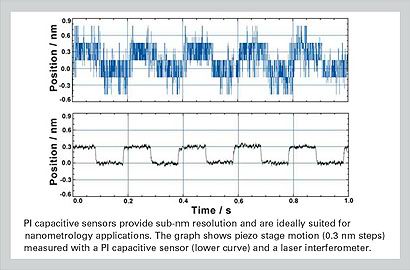
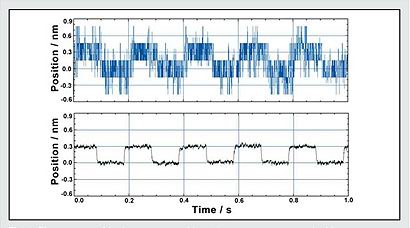
Figure 1 shows a D-015, 15 µm capacitive position sensor and an interferometer,
both measuring nanometer-range actuator cycles. The graphs clearly show the superior resolution of the capacitive position sensing technique.
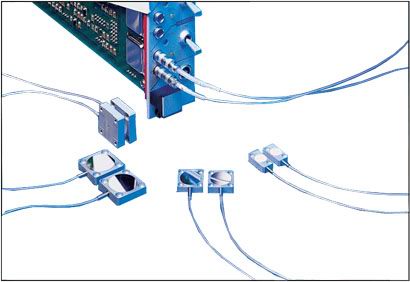
D-050 Capacitance Sensor Probes.
Fig 1. Piezo
nanopositioning system making 0.3 nm steps, measured with PI capacitive sensor (lower curve) and with a laser interferometer. The capacitive sensor can provide even higher resolution than the interferometer
Stability and Linearity of PI Capacitive Position Sensors
PI capacitive position sensor electronics incorporate a proprietary design providing
superior linearity, low sensitivity to cable capacitance, low background noise and low drift.
The Integrated Linearization System (ILS) compensates for influences caused by errors, such as non-parallelism of the plates.
When used with PI digital controllers (which add polynomial linearization techniques) a positioning linearity of up to 0.003 % is achievable.
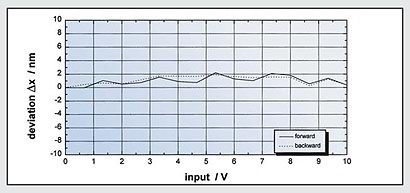
Figure 2 shows the linearity of a P-752.11C piezo flexure nanopositioning stage with integrated capacitive position sensor operated in
closed-loop mode with an analog controller. All errors contributed by the mechanics, PZT drive, sensors and electronics are included in the resulting linearity of better than 0.02 %.
Even higher linearity is achievable with PI digital controllers.
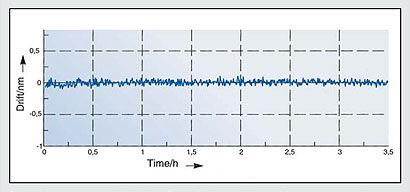
The exceptional long-term stability of the PI capacitive position sensor and electronics design is shown in Figure 3.
Fig 2. Linearity of a P-752.11C, 15 µm piezo nanopositioning stage operated with E-500/E-509.C1 control electronics.
The travel range is 15 µm, the gain 1.5 µm/V. Linearity is better than 0.02 %; even higher linearity is achievable with PI digital controllers
Fig. 2
Fig 3. Measurement stability of an E-509.C1 capacitive position sensor control board with 10 pF reference capacitor over
3.5 hours (after controller warm-up).
When measuring distance by detection of capacitance changes, fluctuations in the cable capacitance can
have an adverse effect on accuracy. This is why most capacitive measurement systems only provide satisfactory results with short, well-defined cable lengths.
PI Systems use a special design which eliminates cable influences, permitting use of cable lengths of up to 3 m without difficulty. For optimum results, we
recommend calibration of the sensor-actuator system in the PI Metrology Lab.
Signal Paths to 15 Meters and More
Longer distances between sensor and electronics can be spanned with special, loss-free, digital transmission protocols.
A remote sensor interface box is available for PI digital controllers .
Features & Advantages, Applications
Two-plate capacitive sensor working principle.
Quality control and long-term stability testing of capacitive displacement sensors at PI.
Custom, 7-channel, capacitive position sensor electronics.
Working principle of STM (scanning tunneling microscope) with
integrated capacitive position sensors
Properties of PI Sensors
Highest resolution (0.01 nanometer) of all commercially available position sensors
Measuring ranges of up to 1 mm
Ideal for parallel metrology applications
Linearity to 0.003%
Extremely high long-term stability (better than 0.1 nm / 3 hours)
Vacuum compatible
Bandwidth to 10 kHz
Invar versions for highest temperature stability (5 x 10⁻⁶ / K)
Multi-channel digital electronics available
Compatible with PI nanopositioning system servo-controllers
Two-plate and single-plate sensors
Custom models
Reasons for Choosing PI
Over 30 years experience in designing ultra-high-precision mechanics
In-house design & manufacture of sensors and electronics
State-of-the-art equipment for simulation, production and testing
State-of-the-art metrology lab with multiple thermal, acoustic and
seismic isolation for meaningful sub-nanometer measurements
In-house controller development
PI has the most-experienced nanopositioning systems development and production teams in the field
Tutorial: Capacitive Position Sensors – Measuring Displacement with Sub-Nanometer Precision
Glossary
Measurement Range
The measurement range depends on the size of the active sensor area as well as on the electronics used.
Due to PI’s proprietary signal conditioner electronics design,the mid-range distance is always identical to the selected measurement range. The probe-to-target gap may vary from 50% to 150% of the measurement range (see Fig. 14).
The sensor capacitance is the same as that of the reference capacitance in the electronics. Different reference capacitance scan be used to extend the nominal (standard) measurement range (see Fig. 15).
Fig. 14: Definitions: measurement range and mid-range distance have identical values
Target
Two-electrode capacitive sensors consist of two electrodes, named probe and target. Single-electrode sensors measure against a surface that is called the target.
The target surface is, in principle, a conductive material electrically connected to ground. Measurement against semiconductors is possible as well.
While two-plate capacitive sensors consist of two well-defined high-quality planes, with single-plate sensors, target surface characteristics can influence the results. A curved or rough surface will deteriorate the resolution because the results refer to an average gap (see Fig. 16 and 17). Surface shape also influences the homogeneity of the electric field and thereby the measurement linearity. For factory calibration, a target plane that is considerably larger than the sensor area is used.
Fig. 15: Measuring ranges of different PI capacitive position sensors (standard ranges in blue, extended ranges in black)
Environment
Precision measurement with nanometer accuracy requires minimizing environmental influences. Constancy of temperature and humidity during the measurement are as essential as cleanliness.
Electronics from PI are basically very temperature stable. Temperature drift is under 0.2% of full measurement range with a change of temperature of 10 C°. Temperature changes also cause all material in the system to expand or contract, thus changing the actual measured gap.
The influence of a change in relative humidity of 30 percentage points is less than 0.5% of the measurement range. Condensation must always be avoided. Dusty or damaged sensor surfaces will also worsen the measurement quality.
Environmental conditions at the time of calibration are noted on the calibration sheet PI provides with each individual system.
Fig. 16: Roughness of the target surface downgrades resolution and linearity
Fig. 17: Curved surfaces lead to an averaged distance measurement
PI Solutions for Nano-Measuring / Positioning
Introduction
Measurement Ranges from 10 up to 500 µm and More
Sub-Nanometer Position Resolution
Non-Contact Absolute Measurement of Displacement /Motion / Vibration
Immune to Wear and Tear
Ideal for Multi-Axis Applications
Improved Linearity with ILS Signal Electronics
High Bandwidth up to 10 kHz
Measures Position of the Moved Interface (Direct Metrology)
High Temperature and Long-Term Stability
Vacuum CompatibleCompact 1- and 2-Electrode Sensors, Custom Designs
Guard-Ring Electrode Eliminates Boundary Effects
One- and Two-Plate Sensors Capacitive sensors perform non-contact measurements of geo-metric quantities representingdistance, displacement, separa-tion, position, length or other lin-ear dimensions with sub-nanometer accuracy. PI offerscapacitive sensors for the inte-gration in user applications intwo-plate-capacitor versions forhighest performance and asPISeca™ single-electrode sensors, for more flexibility and easier integration.
Nanopositioning and Nanometrology PI offers the widest range of high-dynamics and high-resolution nanopositioning systems worldwide. The precision and repeatability achieved would not be possible without highest-resolution measuring devices. Capacitive sensors are the metrology system of choice for the most demanding nanopositioning applications. The sensors and the equally important excitation and read-out electronics are developed and manufactured at PI by expert teams with long-standing experience.
Measurement Principle The measurement principle in both cases is the same: two
conductive surfaces set up a homogenous electric field; for short distances, the applied voltage is proportional to the distance between the plates. Dual-plate sensors measure the distance between two well-defined sensor plates with carefully aligned surfaces which generate the most accurate electric field and hence provide optimal results. Single-plate capacitive sensors measure the capacitance against electrically conductive references, such as metallic plates, and are very convenient to install and connect.
Test and Calibration PI’s nanometrology calibration laboratories are seismically, electromagnetically and thermally isolated, and conform to modern international standards.
PI calibrates every capacitive measurement system individually, optimizing the performance for the customer’s application. Such precision is the basis of all PI products, standard and customized, and assures optimum results in the most varied of applications.
Function, Properties, Advantages
Introduction
In the field of nanopositioning, as well as for scanning and metrology applications, capacitive measurement systems from PI provide highest accuracy available at various measurement ranges. Capacitive sensors achieve the best possible measurement linearity and excellent long-term stability. The sensors provide contact-free measurement of the actual position of the moving part (direct metrology) with sub-nanometer precision. Accuracy, linearity, resolution, stability and bandwidth are far better than with conventional nano-metrology sensors like LVDT or strain gauge sensors. Non-contact operation means no parasitic forces influencing the application and results in measurement free of friction and hysteresis.
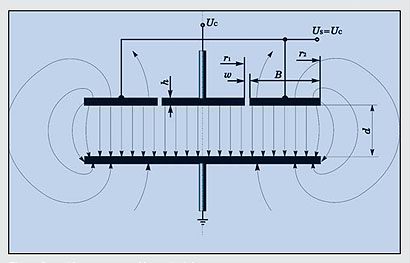
Guard-Ring Design for Improved Linearity Sensor design has a strong influence on linearity. The superior PI design uses a guard-ring electrode that eliminates sensor electrode boundary effects. This ensures a homogenous field in the measurement zone and results in higher measuring linearity.
Single- and Multi-Channel Electronics
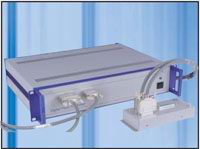
PI’s signal conditioner electronics are specially designed for high bandwidth, linearity and ultra-low noise and are perfectly matched to the various PI sensor probes. PI offers signal conditioner electronics and controllers for one to three channels. The E-509 multichannel modules plug into the modular E-500 / E-501 controller chassis. Bandwidth and measurement range can be factory- set to meet the specific needs of each application. The E-852 one-channel signal conditioner electronics for PISeca™ single-plate sensors are designed as stand-alone systems with user-selectable bandwidth and range setting and can be synchronized to operate in multi-channel applications.
Higher Linearity through ILS Electronics
All of PI’s signal conditioning electronics are equipped with the PI proprietary ILS linearization circuit that minimizes nonparallelism errors.
Easy Handling and Integration
PISeca™ single-electrode sensors are particularly easy to install in a measurement system. On the single-channel electronics, an LED-bar indicates the optimum probe-to-target gap for the different measurement range settings. The multi-channel electronics come optionally with displays and/or a PC interface on a module in the same housing.
Ideal for Closed-Loop Piezo Nanopositioning
Closed-loop nanopositioning systems may be controlled by sensor / servo-controller modules of PI’s E-500 series. Such modules are available for connecting up to three position sensors, either stand-alone or integrated into the motion system. Closed-loop operation eliminates the drift and hysteresis that otherwise affect piezo actuators.
For nanopositioning tasks with the most stringent accuracy requirements PI offers high end digital controllers.
Capacitive 2-plate sensors from PI, here D-100.00
Nanopositioning / Nanomeasuring
Resolution / Bandwidth
Resolution in nanopositioning relates to the smallest change in displacement that can still be detected by the measuring devices.
For capacitive sensors, resolution is in principle unlimited, and is in practice limited by electronic noise. PI signal conditioner
electronics are optimized for high linearity, bandwidth and minimum noise, enabling sensor resolution down to the picometer range.
Electronic noise and sensor signal bandwidth are interdependent. Limiting the bandwidth reduces noise and thereby improves resolution. The working distance also influences the resolution: the smaller the working distance of the system, the lower the absolute
value of the electronic noise.
Figure 1 shows measurements of nanometer-range actuator cycles taken with a D-015, 15 ìm capacitive position sensor and a laser interferometer. The graphs clearly show the superior performance of the capacitive position sensing technique.
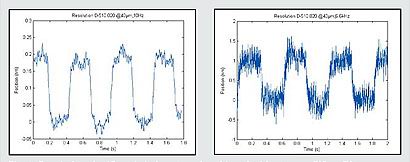
Figure 2 illustrates the influence of bandwidth upon resolution: the PISeca™ single electrode sensors show excellent resolution down to the sub-nanometer range, even at high bandwidths.
Linearity and Stability of PI sensors
The linearity of a measurement denotes the degree of constancy in the proportional relation between change in probe-target distance and the output signal. Usually linearity is given as linearity error in percent of the full measurement range. A linearity error of 0.1% with range of 100 µm gives a maximum error of 0.1 µm. Linearity error has no influence whatsoever upon resolution and repeatability of a measurement.
Linearity is influenced to a high degree by homogeneity of the electric field and thus by any non-parallelism of the probe
and target in the application. PI capacitive position sensor electronics incorporate a proprietary design providing superior linearity, low sensitivity to cable capacitance, low background noise and low drift. The Integrated Linearization System (ILS) compensates for nonparallelism influences.
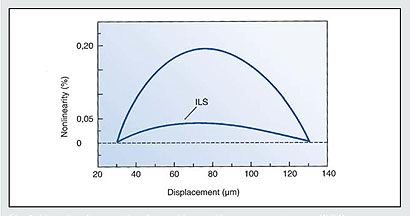
A comparison between a conventional capacitive position sensor system and a PI ILS system is shown in Figure 3. When used with PI digital controllers (which add polynomial linearization) a positioning linearity of up to 0.003 % is achievable.
Figure 4 shows the linearity of a P-752.11C piezo flexure nanopositioning stage with integrated capacitive position sensor operated in closed-loop mode with an analog controller. All errors contributed by the mechanics, PZT drive, sensors and electronics are included
in the resulting linearity of better than 0.02 %. Even higher linearity is achievable with PI digital controllers like the E-710.
Stability of the measurement is limited mainly by thermal and electronic drift. For accuracy and repeatability reasons, it is thus necessary to maintain constant environmental conditions. The exceptional longterm stability of the PI capacitive position sensor and electronics design is shown in Figure 5.
Principle of the Measurement
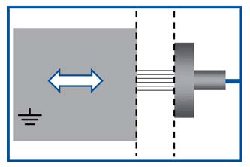
Signal/Displacement Proportionality When a voltage is applied to the two plates of an ideal capacitor, it creates a homogenous electric field. This principle is the basis of measuring displacement with capacitive position sensors. For small gaps, the applied voltage is proportional to the plate distance. The planes of the sensor surface (“probe”) and the target form the two capacitor plates.
The target should not be below a certain size because of boundary effects. This is important for applications with, say, a rotating drum as target. For metallic materials, the thickness of the target has no influence on the measurement.
Guard Ring Geometry/Design
The proportionality referred to is based on the homogeneity of the electric field. To eliminate boundary effects, the superior PI design uses a guard-ring electrode that surrounds the active sensor area and is actively kept at the same potential (see Fig. 7). This design shields the active sensor area and provides for excellent containment of the measurement zone. Thus optimum measuring linearity over the full range is achieved within the specified accuracy.
Calibration for Best Accuracy
PI’s nanometrology calibration laboratories offer optimum conditions for factory calibration. As references, ultra-highaccuracy incremental sensors like laser interferometers are used.
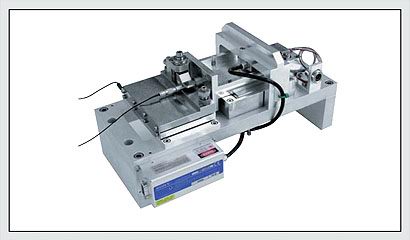
PISeca™ systems are calibrated at PI with a NEXLINE® positioning system having a closed-loop resolution better than 0.01 nm in a test stand with friction-free flexure guidance and an incremental reference sensor featuring a resolution better than 0.1 nm (Fig. 8
and 9).
Special Design Eliminates Cable Influences
When measuring distance by detection of capacitance changes, fluctuations in the cable capacitance can have an adverse effect on accuracy. This is why most capacitive measurement systems only provide satisfactory results with short, well-defined cable lengths.
PI systems use a special design which eliminates cable influences, permitting use of cable lengths of up to 3 m without difficulty. For optimum results, we recommend calibration of the sensor-actuator system in the PI metrology lab. Longer distances between sensor and electronics can be spanned with special, loss-free, digital transmission protocols.
Electrode Geometry, Sensor Surface Flatness
and Finish
During sensor production, great care is taken to maintain critical mechanical tolerances. Measuring surfaces are diamond machined using sophisticated process control techniques. The result is the smooth, ultra-flat, mirrored surfaces required to obtain the highest resolution commercially available.
Parallelism of Measuring Surfaces
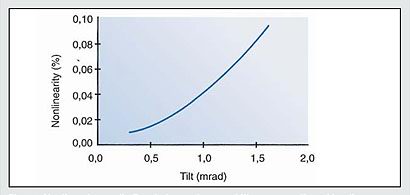
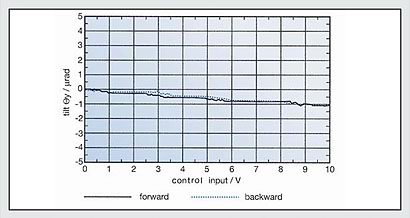
For optimum results, target and probe plates must remain parallel to each other during measurement. For small measurement distances and small active areas, any divergence has a strong influence on the measurement results. Tilt adversely affects linearity and gain, although not resolution or repeatability (see fig. 12). Positioning systems with multilink flexure guidance reduce tip and tilt to negligable levels (see Fig. 13) and achieve outstanding accuracy.
Fig. 10: Capacitive position sensors in an
ultra-high-accuracy, six-axis nanopositioning
system designed by PI for the
German National Metrology Institute
(PTB). Application: scanning microscopy
Fig. 11: Digital sensor-signal transmission
(DST) allows a distance up to 15 m
between positioning unit and controller,
here an E-710 multi-axis digital piezo
controller
Fig. 1: Piezo nanopositioning system making 0.3 nm steps, measured with PI capacitive sensor (lower curve) and with a highly precise laser interferometer.
The capacitive sensor provides significantly higher resolution than the interferometer
Fig. 2: Resolution significantly below 1 nm is achieved with a 20 ìm PISeca™
single-electrode sensor (D-510.020) and the E-852 signal conditioner electronics.
Left: 0.2 nm-steps under quasi-static conditions (bandwidth 10 Hz),
right: 1 nm-steps with maximum bandwidth (6.6 kHz)
Fig. 3: Linearity of conventional capacitive position sensor system vs. PI ILS
(integrated linearization system), shown before digital linearization
Fig. 4: Linearity of a P-752.11C, 15 ìm piezo nanopositioning stage operated with
E-500/E-509.C1A control electronics. The travel range is 15 ìm, the gain 1.5 ìm/V.
Linearity is better than 0.02 %; even higher linearity is achievable with PI digital
controllers
Fig. 5: Measurement stability of an E-509.C1A capacitive position sensor control module with 10 pF reference capacitor over 3.5 hours (after controller warm-up)
Fig. 6: Capacitive sensor working principle
Fig. 7: Capacitive sensors with guard ring design provide superior linearity
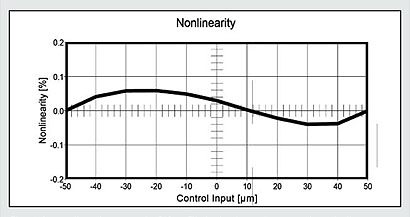
Fig. 8: Output linearity error of a PISeca™ single-electrode system is typically
less than 0.1% over the full measurement range
Fig. 9: Ultra-high-precision NEXLINE® positioning system with incremental sensor in a calibration and test stand for PISeca™ sensors. The resolution is significantly better than that of a laser interferometer
Fig. 12: Nonlinearity vs. tilt. Resolution and repeatability are not affected by tilt
Fig. 13. Flexure-guided nanopositioning systems like the P-752 offer submicroradian
guiding accuracy and are optimally suited for capacitive sensors
Tutorial cont.
Capacitive displacement sensors measure the shortest ofdistances with highest reliability. The quantity measured is the change of capacitance between sensor plate and the target surface using a homogenous electric field. Accuracies in the sub-nanometer range are regularly achieved. Absolute measurement is possible with a well-adjusted, calibrated system.
One application of high-resolution displacement measure-ment is for nanopositioning.Two-plate capacitive sensors can measure distance, and hence position, of a moving object with excellent precision.The high sensor bandwidth allows closed-loop control in high-dynamics applications.
Closed-loop, multi-axis nano-positioning tasks are realized with high-performance positioners that make use of direct metrology and parallel kinematics. This allows measuring all degrees of freedom at the same time, which compensatesguiding errors (Active Trajectory Control concept). Here, capacitance gauges are the most precise measuring systems available, and give the best position resolution results.
Integrating capacitive sensors in a system is a good way to measure tip/tilt motion precisely. The moved object’s tip angle is measured differentially, and, if required, compensated out.
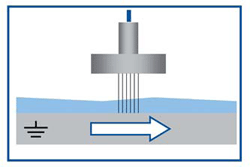
Measuring the thickness of a film or layer of non-conducting material on a moving, conductive, surface (e.g. a rotating drum) is an ideal job for capacitive sensors due to their non-contact operation and their high dynamic performance.
Compensation of undulating and oscillating motion, e.g. inconstant height scans or in white-light interferometry, are applications for which capacitive sensors are especially well-suited.
Measuring Straightness and Flatness / Active Cross-Talk Compensation
Force Sensors with Micronewton Sensitivity
Vibration, Flatness, Thickness
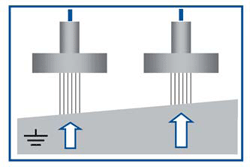
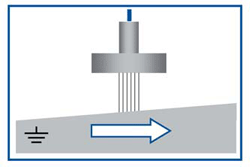
Excellent resolution in straightness and flatness measurements over long travel ranges is achieved with capacitive single electrode sensors. One application is measuring cross-talk in nanopositioning. Crosstalk, off-axis motion from one actuator in the motion direction of another, is detected immediately and actively compensated out by the servo-loops. The high sensor bandwidth provides excellent dynamic performance.
Single-electrode capacitive sensors, which measure sub-nanometer displacement from a distance with no contact, are frequently used as high-resolution force sensors. In a system having suitably well-defined stiffness, the measured displacements translate to forces with resolutions in the micro-newton range, all without influencing the process being measured.
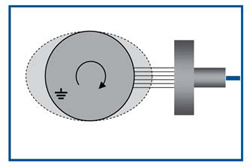
The high dynamics of the PISeca™ capacitive gauge system even allows measurements of vibrations and oscillations with excellent resolution. Flatness of a rotating work-piece or differences in thickness in the nanometer rangecan be detected. One field of application is in the production of disk drives or in active compensation of vibration.
Servo controller module for piezo nanopositioning systems featuring two-plate sensors, upgradeable with piezo amplifier module, display or PC interface/display module






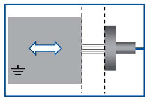
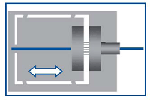
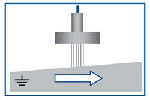
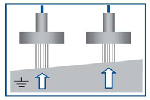
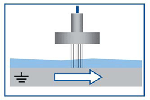
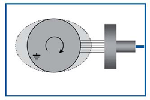
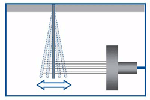
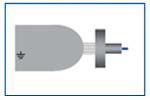
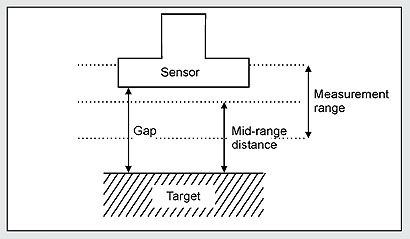
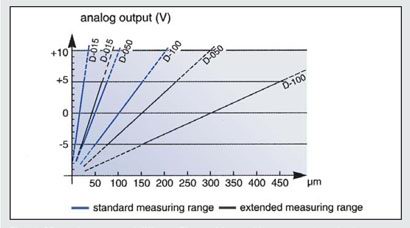

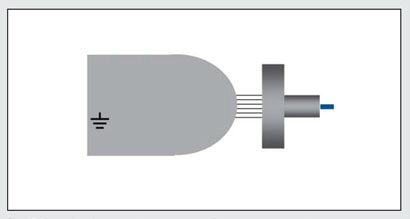 Fig. 17: Curved surfaces lead to an averaged distance measurement